When you stick at it (Maintenance)
June 5th, 2026 Stages of Change
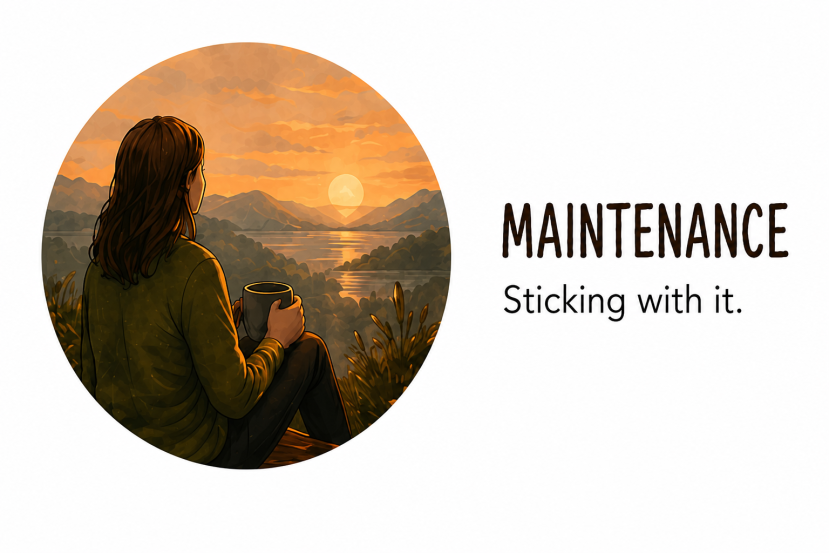
This article is about Stage 5 of the 'Stages of Change' model.
For an overview of the entire model go here.
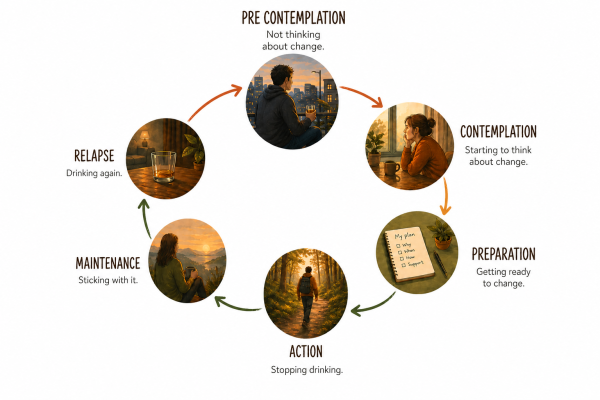
The fifth recognised stage of the change process comes after you've done a bunch of thinking, undergone a bunch of prepping, exerted a bunch of effort, and now you're embarking on a longer-term focus. It's the stage where you start to understand yourself a bit better, what works, what doesn't, and what might need some further investigation. Officially this stage is called MAINTENANCE.
Being in the Maintenance stage involves consolidation and bedding in new behaviours. It's about exploring and developing tools to help you deal with stress, sadness and frustration (insert any and all emotions here). It's where you start addressing issues that may have been masked by alcohol for many years, perhaps inter-personal relationships start shifting, and maybe you reach out for external support and care.
Maintenance doesn't require quite the same level of time and energy as Action, but you'll still find yourself here thinking a lot about how to fill your days, deal with situations and manage your emotions. In Maintenance, some of the tools and techniques that you started using in the early days might not work quite so well now you're down the track a bit. Or you're bored of them and you want to try new things. So the exploration still goes on - different books and media, different supports, different techniques. But whatever is going on in Maintenance, some of the heat of the new will often be fading.
"Probably around the three-to-six-month mark life seemed to get a little easier," shares David in his Sober Story. "I had a regular physical fitness regime which really helped me to feel better. I was still In AA and although I’d never felt comfortable there it did work for me more than other interventions. I started to relax a bit more and became more accepting of this new lifestyle."
"Learning to deal with all the emotions was super hard," shares a Living Sober member. "I was slobbery mess a lot of year one and well into year two. Or I was high as a kite on life (which I actually discovered was a bigger trigger for me than my slobbery state). I guess I learned to just let the feelings come and actually feel them and it was ok if I was shitty or whatever. It was also great when 2 doctors said to me that quitting drinking was the single best thing I could do for my health. Reinforcement of good choices made."
Positive reinforcement from the people around you is a huge boost when undergoing change. It might come in the form of supportive dialogue from health professionals. Or in the actions of your loved ones.
"Friends who actively supported me by doing things like having alcohol-free drinks in their fridge when I visited or might call ahead to the restaurant we were meeting at to see if they’ll allow you to BYO your favourite alcohol-free drink," one Living Sober member revealed. "Also not having your friends pressuring you to drink and just quietly accepting it are great too of course…but the active encouragement/endorsement of a different choice does feel good."
"My family does that too- it really makes you feel recognized 💜", shared another member. And another said, "It's so great when people are being thoughtful when socializing and with their support in general. People asking "are you still doing the not drinking thing," is not helpful and my brain would be screaming "what part of alcoholic do you not get?!" People also telling you that you look super well and sound super relaxed are also lovely (and usually completely random) reminders that you're very much on the right path."
For one Living Sober member it was the reaction of a complete stranger that felt so supportive and good, when her significant other was having trouble readjusting to her new non-drinking status. "I went with my not supportive at all husband to a winery. I think he thought it would get me to drink again. This was at about six months sober. The hostess at the tasting was so happy about me being a non drinker. They were prepared for it and brought out a gorgeous non-alcoholic fruity type drink in a massive martini glass and several fancy snacks. They treated me so well. It made me realize that I wasn’t the only non-alcoholic person showing up with boozy friends."
It's important to note that for some people entering the Maintenance phase after some time spent not drinking, actually leads to uncovering some sort of underlying issue that needs addressing. Perhaps something that the alcohol has been masking for many years. This could be to do with a difficult relationship that need reshaping, a work or home environment that needs shifting, or a physical or mental health issue that needs some specialised attention.
The latter was certainly the case for Matt, a writer who shared in his Sober Story, "The first year was up and down emotionally. I was rolling from highs to lows. It was in the second year when my not drinking became bedded in as something I didn’t have to think about so much. But the two years since then have been a rollercoaster of dealing with anxiety, panic attacks and a major depressive episode. It was during that time I have felt grateful for being sober – that I didn’t have a depressant added to the mix."
Maintenance is a phase that can go on for years. A never ending series of sober days, months and years that become less and less about not drinking, and more just about dealing with (as the cliche goes), life on life's terms. However for some (not all) people, there is one final stage that can occur in the cycle.
To read about the next stage of change, Relapse, go here.
For an animated video about the Stages of Change model, go here.
This article has been written, and quotes gathered, by Living Sober Community Manager Lotta Dann.
Please add your own input in the comments below. Are you at this stage now? How's it going? Or have you been through this process? Share your thoughts and insights.
Continue reading

Sober Story: Tricia
This week’s Sober Story comes from Patricia (Tricia), a 29-year-old living in South Florida.
June 6, 2019 – 15 comments
It's hard work
Many people find being a human so hard that they turn daily to brain bending liquids to help them cope.
March 30, 2026 – 18 comments
Sobriety Chat: Tommy
Listen to writer and counsellor Tommy talks about the powerful realisation he had about alcohol, how sobriety fuelled his passion to help others, the work he does with clients helping them deal with uncomfortable emotions and what he thinks will help more men into recovery.
May 10, 2023 – 1 comment
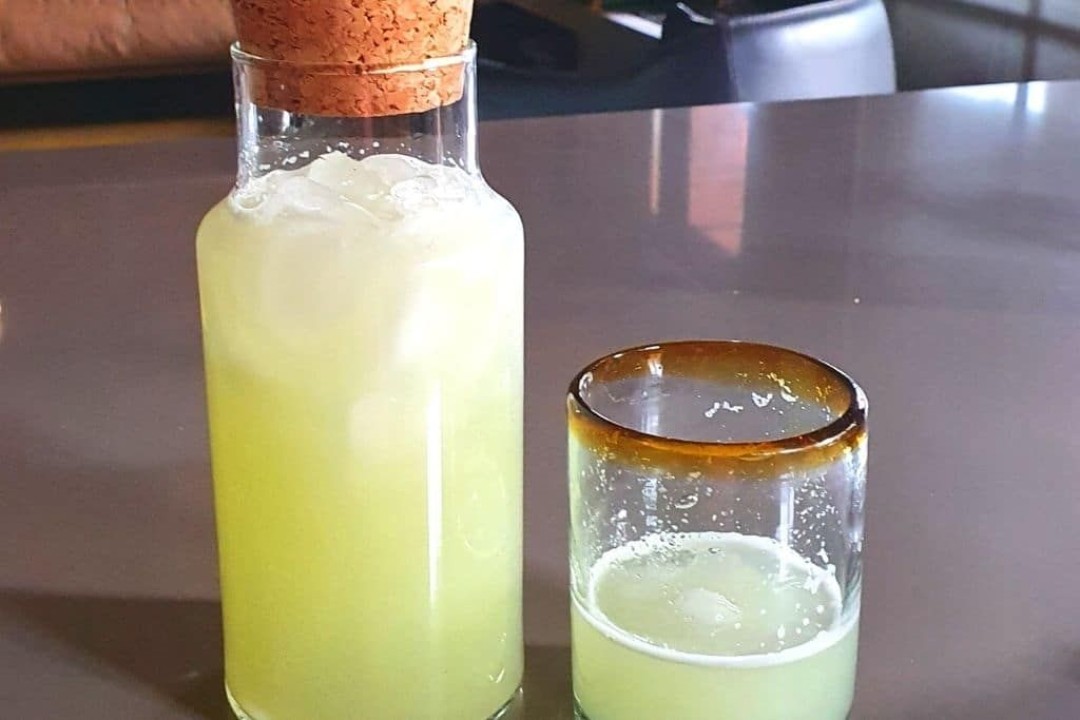
Agua Fresca
This recipe comes from @suek who says: “I’ve been living in Mexico for the past 7 months.
May 23, 2021 – 5 comments