When slip-ups occur (Relapse)
June 5th, 2026 Stages of Change 1 comment
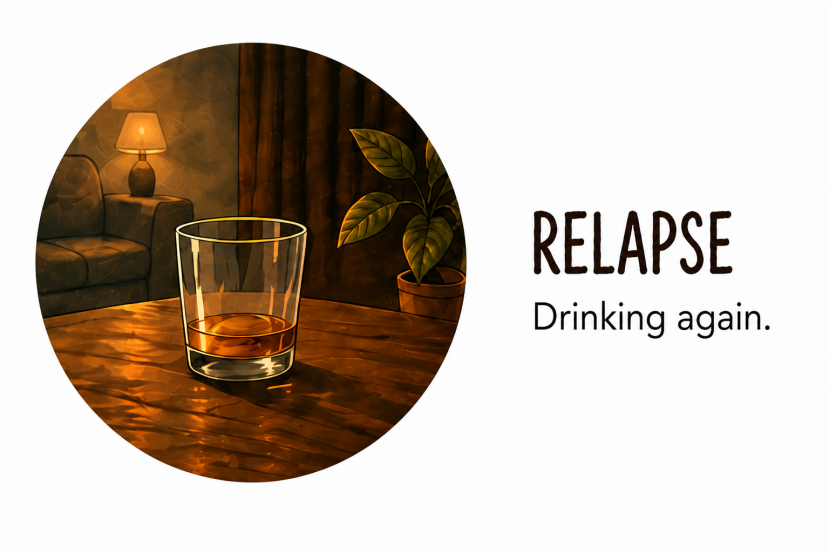
This article is about Stage 6 of the 'Stages of Change' model.
For an overview of the entire model go here.
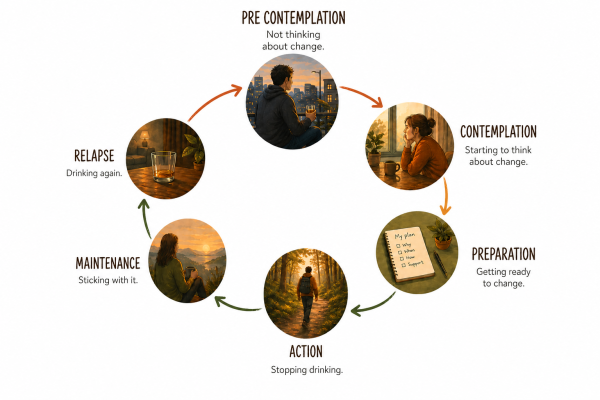
The sixth and final recognised stage of the change process is one that occurs for many people, but not everyone. It's the stage where for some reason, or combination of reasons, despite all the work that has gone on mentally and with your social life and environment, a slip occurs and you return to previous behaviours. Officially this stage is called RELAPSE.
Relapse is often talked about as a 'slip-up' or a 'lapse', but in actual fact - those are different things. A 'slip-up' or 'lapse' are brief. Perhaps just one or two instances of drinking again. These can be rough and upsetting, but are relatively easy to move past and get back to where you were before.
Relapse is more of a prolonged return to previous drinking behaviours, where you're back in it for some time. This can apply for people who had stopped drinking altogether (their goal was full sobriety and that's what they've been doing), and also for those who have cut back drastically (their goal was reducing and limiting their intake and that's what they've been doing). In both of those scenarios, relapse can be brutal. It brings back all the old feelings of guilt and low self-esteem. It comes with embarrassment and shame, and once again the thinking, thinking, thinking about drinking.
"I had one relapse," says Anna in her Sober Story. "It was around 6 months after I gave up. I drank two bottles of wine at home on my own. I can’t remember what had happened to trigger it, but I had convinced myself that it was a bad enough day that I needed a drink. I was so ill and twisted up with anxiety the next day that it ended up being the best possible reminder of why drinking could never be a part of my life again."
One key feature of Relapse is that it takes you back to a world of inner turmoil. Flip-flopping back and forth with thoughts heading this way and that. One minute feeling defiant and feisty, working hard to push aside any guilt or shame, the next telling yourself that you're weak and stupid, questioning why you undid all your hard work.
"For me it is a delicate balance between telling myself I’m a hopeless failure and saying it’s ok…so let’s drink again." says one Living Sober member. "I go back and forth between giving myself tough love vs kindness."
"My relapse sent me back into such sadness and guilt that I could hardly function for weeks," shares another. "I might have looked like I was happy to be drinking again but I wasn't. My sleep was crap so I was exhausted and my anxiety was intense. The cravings were back and I struggled to drive home every day without going to the bottle shop. I was masking and hiding and once again feeling like a fraud, hiding things and not being my authentic self."
It can't be ignored that one of the biggest factors everyone giving up alcohol is contending with is the environment we live in, where alcohol is championed and celebrated and readily available. Oftentimes, people who have experienced Relapse will tell you that the alcohol-soaked world we live in played a big part in leading them to drink again.
"I had stopped for a while, but recently relapsed again after going through an accident, and it reminded me how easy it is to fall back into the cycle," shares another member. "I think alcohol is so widely promoted and normalised that it can make stopping really hard. It’s everywhere, and even just going out with friends or being around others who drink can pull you back into old habits without even realising it."
Another member agrees. "My slips have always come in conjunction with wanting to feel connected to the people around me who are drinking, my best friends, my husband, my sisters. Or it would be related to an extremely stressful event which would take me down a rabbit hole for one night. There would be a point where I would give up, supports were not in place and things felt too hard. What always brought me back was always the same thing - wanting to not hurt my family, knowing that my health might suffer."
As hard as they are to live through, Relapses can also bring some gifts in terms of lessons learned. A Relapse will help you identify what your triggers are. People? Places? Emotions? It will also make plain if the supports you have in place are correct, plentiful enough or even working.
"I would also say that my coping skills were pretty poor other than drowning in a sea of booze (so not really coping at all!) and to stop that relapse/sober/relapse cycle it’s really vital to find ways to build in a time delay between the thoughts of drinking and the action," shares a member. "If it’s possible to get through to the next morning then it’s possible the urgency has subsided and you can try for another sober day."
"For me, relapses previously have been lack of support and either pushing the F it button on a bad day seemingly out of nowhere, or kidding myself I’d been sober long enough now to moderate." says another. "We all know how that ends. This time, the time sobriety has actually stuck, I knew I was breaking up with booze for good, but critically, I stopped lurking on this site and started posting for support and connection, and, I told myself if I slipped up again I wouldn’t disappear in shame and lose myself back into booze, but I’d front up immediately and get support and move forward. Thankfully that hasn’t happened yet, but all sober time is a win and there’s no shame in setbacks on an upward trajectory of sober time."
Having experienced multiple relapses, one member has learned many lessons. "I have a few scenarios that always get me back to drinking," they say. "Increased stress (work/family) or peer pressure/fomo. Also, linked experiences e.g. going to the rugby - have to have a drink. Going to the snow so have to have mulled wine. Going on holiday - of course I'm having airport drinks. I try to journal about it (my iphone has a journal app) and reflect on both the positives and negatives of “slip ups”. Reading my reflections can be really helpful. Following sober inspo on social media can be helpful, but also sometimes annoying. Sober literature is helpful. Self compassion and being gentle to myself is more helpful than my usual self criticism!"
It is often stated that Relapse is common, which is helpful in keeping people moving forward so they don't feel completely broken if they've had one. It's also interesting to hear this Living Sober member talk about how too much 'Relapse is normal' dialogue can actually be unhelpful. "In my first few weeks, when I was perusing sober podcasts and sober social media hoo-ha, it felt like it was mentioned SO MUCH about how if you relapse don't beat yourself up it happens, and everyone's been there etc; it almost felt like I was being given permission to relapse, like it was expected. So every time I had a craving I would think "is this it, is this my time to relapse?" It really played on my mind as an option that was OK, almost maybe even "badge" worthy as being on the true alcohol problem to sober journey. I get it though, relapses are truly just one pour away, and forgiveness of yourself is vital, and it's fantastic that there is so much support and empathy for when/if that happens."
The Stages of Change diagram shows Relapse pointing directly back to Pre-Contemplation. And while there can sometimes be an aspect of returning to being unaware of negative impacts, it's more likely to be due to wilful denial rather than a genuine lack of awareness. Because truth be told, you can't go through all the stages and not change. You can't undo all of the deep internal work that has gone on. And you can't forget all that you've learned.
"One thing I’ve learned is that relapse doesn’t mean you don’t want sobriety or that all your progress is gone. Sometimes life hits hard and people go back to what they used to cope. Right now I’m trying to stop again because I can already feel how much better things were when I wasn’t drinking, but yeah, it’s tough."
Recovery is tough, sobriety is hard-won. Relapses are brutal, but they're not the end of the road. Keep going. Believe in yourself. Remember why you're doing this. Reach out and connect with others going through the same thing. Reach out to trained professionals. Build your toolbox. And trust that the day will come when you are far enough away from your last drink that you are truly free. When you'll look at alcohol and wonder what all the fuss was about. And when that day comes, you'll be full of gratitude and pride for the version of you that did all the hard work to quit.
For an animated video about the Stages of Change model, go here.
This article has been written, and quotes gathered, by Living Sober Community Manager Lotta Dann.
Please add your own input in the comments below. Are you at this stage now? How's it going? Or have you been through this process? Share your thoughts and insights.
Continue reading
Blueberry & Honey Sparkling Lemonade
This drink is easy to make but feels really treaty.
September 27, 2019 – 1 comment
Sober Story: Rowan
This week’s Sober Story comes from Rowan (she/her), a 56-year-old living in Western Australia.
August 14, 2019 – 15 comments
Mulled Pear & Ginger
Enjoy this concoction warm straight off the stove or leave it to cool and pour it over ice with a bit of fizzy water added on top.
August 24, 2018 – 1 comment