When the worries begin (Contemplation)
June 5th, 2026 Stages of Change
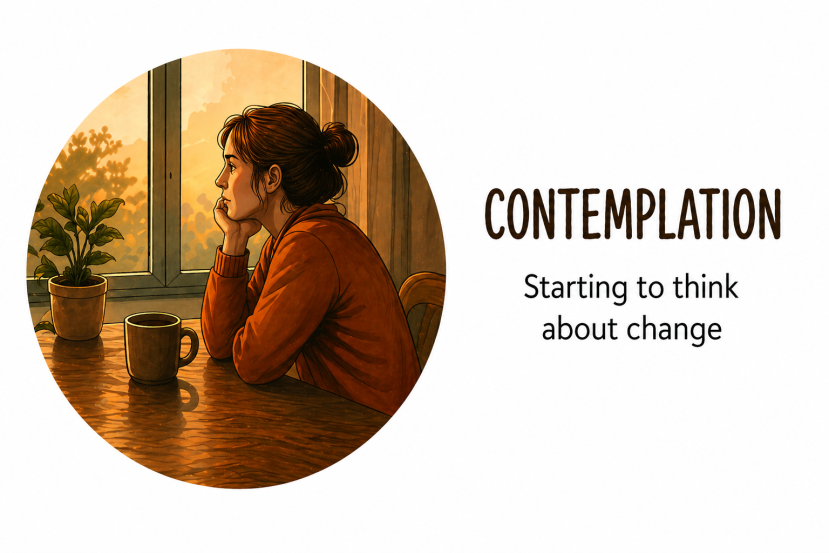
This article is about Stage 2 of the 'Stages of Change' model.
For an overview of the entire model go here.
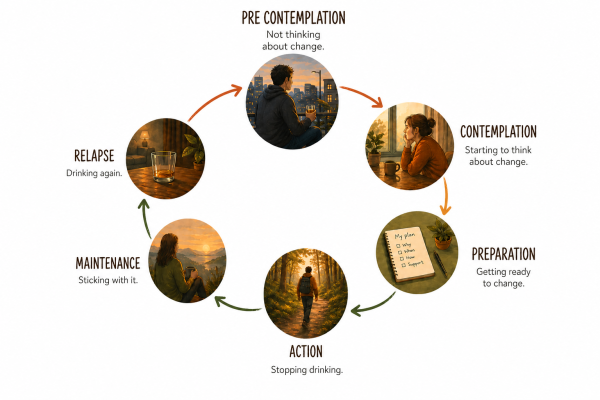
The second recognised stage of the change process is when you're aware that your habit is a problem and you start actively wondering if you need to do something about it. It's the stage when the internal dialogue starts piping up inside your brain and you have more and more thoughts of "is this okay?" and "I'm not sure I can keep going on like this?". Officially this stage is called CONTEMPLATION. It comes before any concrete plans are formed or moves to change are made, but things are definitely starting to shift internally.
When you're at the Contemplation stage, the negative impacts of your habit are obvious. You're aware that you're getting drunk too often. You're conscious of regularly saying or doing things you wish you hadn't. You might be frequently waking up at 3am with a pounding head, sick gut and overwhelming feeling of guilt. You're probably in an endless cycle of making deals and promising yourself that you're not going to drink or only have one or two, but end up breaking those deals and promises regularly. Maybe health concerns are starting to impact your quality of life.
"Bowel issues and heart flutters/palpitations were what really started to concern me," shares one Living Sober member about when they were in the Contemplation stage. "The turning point was going to a work do and waking up with a hangover….on a work day. I ended up coming home an hour after starting work because I felt so gross. I threw up and spent most of the day in bed."
"I remember one specific day about 10 years ago thinking that if I didn't quit soon then liver damage was on the cards and breast cancer," shares another member. "I remember thinking, well perhaps it's best you do get really sick because then you might actually do something about this. But all the while, my intake is increasing. And yep, I did get breast cancer and not even that stopped the drinking. I lied to every doctor (only 3 or 4 bottles of wine a week, bullshit, more like 10 at this point), and the drinking still got worse, I was starting to hide my drinking. I knew it was wrong and out of control but I just couldn't face it all."
For more than one Living Sober member, they stayed at the Contemplation stage for a very long time, because of a fear of moving forward. "There are were so many flags that worried me. But I felt very stuck. Whenever I tried to not drink, I couldn't handle my thoughts and feelings and this overwhelming sense of agitated wrongness, and rage. I literally could not stand myself sober, and that itself generated shame to add to the pile. I now know more about what that all meant, but at the time I was just in it, and really trying to strategise about how to get out of it but finding it very difficult. I spent a couple of decades in this very difficult space. I feel it's really important to acknowledge that the emotional component of getting sober may be overwhelming, genuinely threatening, even impossible to manage for some people, and there's particular support needed for that. Minimising that component just adds to our shame and isolation. If our psyche has been using alcohol to keep us alive and suppress some deep distress, stopping drinking needs to be done carefully and with the right support."
And from this member; "I spent a long, long time here in this stage. Thinking, thinking, overthinking, being paralysed with fear. Resolving for an alcohol free day only to have my resolve dissipate by3pm."
When asked about the Contemplation stage, many Living Sober members reveal that it's what friends, family and health professionals said and the attitudes they held that made all the difference to propel them forward. "The most helpful thing that got me out of the guilt/no worries I’m fine/drinking/guilt cycle, was when people I talked to really took my concerns seriously but also didn’t blow them up or make worse," says one member.
"I had one doctor address my drinking," says another. "I way understated how much I drank. He said no amount of drinking is good for you. I was fully aware that I was hurting myself, but bewildered as to how to stop. It seemed like way too much to quit completely. But I kept blowing past all the moderation guidelines I set for myself. Uggh. I have so much compassion for people caught in the trap."
"I was also telling the Doctor I drank one or two bottles of wine a week, but it was really more like six or seven.," confesses another. "Her reaction was concern and pointed out how alcohol was a carcinogen and two bottles a week was a lot more than the safe limits."
Alongside clear health messages, an attitude of hope and optimism made a positive difference to people in the Contemplation stage. "When I talked to my doctor he was reassuring, gave me some tranquillisers to help with my overall state of worry, and told me that he was confident that I would find a solution. Very supportive." says one member.
It's also interesting to note that if the wrong messages are delivered at the time of someone being in a Contemplation stage, it can do the opposite of moving people forward, and instead keep them stuck. "I hated when people were dismissive and said “You have no problems, a little self medicating never does any harm” shares a member. "It kept me stuck in a state of mind where I knew I was harming myself but it was hard to find motivation and knowledge to listen to my body and act responsibly to quit."
But actually, regardless of what other people are saying and not saying, it comes down to what you yourself are thinking, feeling and believing. That is what will push you along the path to a better life free of guilt, worry and despair. Free from the negative impacts, as this member attests. "The guilt, shame. Will it kill me if I keep rinse repeating? Who are my friends? I couldn't afford to keep doing it financially, physically, emotionally, mentally."
Like with other stages of change, people can spend a long time in this space and looking on it might seem frustrating that they're not moving ahead. Trust that despite things not outwardly appearing different, there could be very powerful moves taking place internally.
To read on about the next stage of change, Preparation, go here.
For an animated video about the Stages of Change model, go here.
This article has been written, and quotes gathered, by Living Sober Community Manager Lotta Dann.
Please add your own input in the comments below. Are you at this stage now? How's it going? Or have you been through this process? Share your thoughts and insights.
Continue reading


Never Again
I remember just before I hit 90 days sober being asked if I’d ever drink again.
November 19, 2022 – 14 comments

Sober Story: Kirst
This week’s Sober Story comes from Kirst, a 46-year-old from Dunedin.
July 3, 2019 – 23 comments