When heavy drinking is normal (Pre-Contemplation)
June 5th, 2026 Stages of Change 1 comment
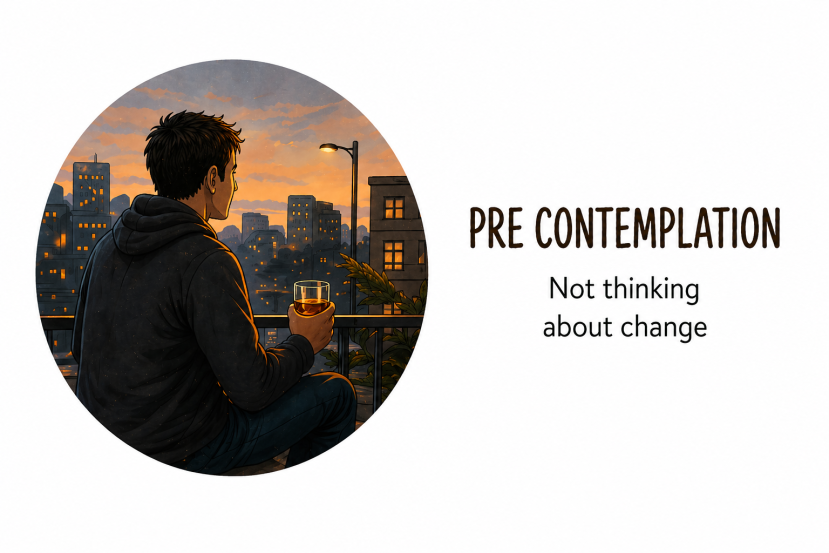
This article is about Stage 1 of the 'Stages of Change' model.
For an overview of the entire model go here.
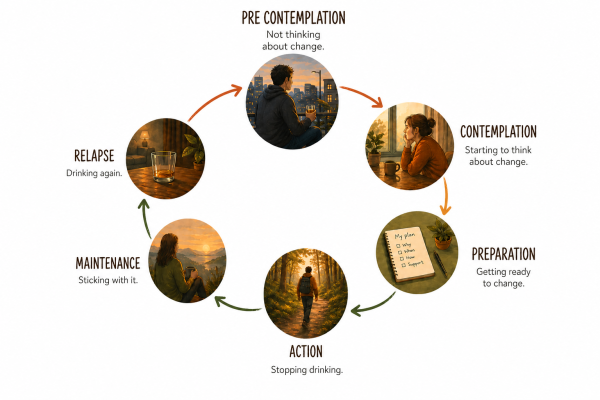
The first recognised stage for someone entering a change process is subtle and covert, it comes before any changes occur in thinking or behaviour. Officially this stage is called PRE-CONTEMPLATION. It can also be described as "the wheels have started falling off but you're not noticing", or "negative impacts are growing but you're not seeing them clearly."
At Pre-Contemplation you may be experiencing tolerance (you can handle drinking higher amounts than usual), withdrawal (more than just a hangover), loss of control (self explanatory) and other negative impacts on your social life, work life, home life, connections with others, connection with yourself, finances, physical health, mental health, ability to function, ability to rely on yourself, and so on and so on.
Negative impacts from addiction are unique to each individual. Some might be obvious (like spending too much money or saying things you regret), but some might be more subtle and harder to identify (like disconnecting from your true feelings or blurring authentic perceptions). Whatever they are, these negative consequences are real and impactful, but at Pre-Contemplation you're not clearly seeing them yet.
Nelson City Councillor Matty Anderson describes in his Sobriety Chat the feeling of being at Pre-Contemplation during his time in the Navy; "I was awesome, that's what I thought, but I was totally wrong. I was out of control and I was hiding kinda trauma and psychological stuff about how it was affecting my life and my thinking. But I didn't realise it. It took years before I thought, oh, my normal was quite bad."
Pre-Contemplation is a crucial stage. Despite the lack of any clear shifts in thinking and behaviour, there is awareness. You might not be fully awake yet, but you're starting to blink your eyes. Explorations are taking place, and there are some fleeting thoughts passing through your mind or comments from others being heard.
"I read a lot about how much was healthy to drink, so I knew I was drinking too much," shares one member. "But I loved books like A Year in Province - stories that showcased heavy drinking as something certain elite cultures do. Or TV shows that showed hard charging, hard drinking women. I thought, “That’s me! No one takes life straight!” But in the morning, when I’d be huddled over the toilet, I had an inkling that maybe I was a victim of false advertising."
"When I was in my mid-twenties and in the thick of 'merrily boozing', I did actually have a friend that wrote me a letter, pulling me up on my bullshit, telling me what I did and said during my blackouts (wasn't pretty, shock horror)" shares another member. "I ripped the letter up, laughed it off and claimed her uptight. At that stage, there was nothing anyone could've said that would've pulled me up by my boot straps, because I didn't think I had a problem, it was "normal" at that age and in my circle."
When asked about the Pre-Contemplation stage, many Living Sober members claim that media representations and societal attitudes that glorify drinking or highlight the so-called benefits of alcohol, also kept them stuck; "The whole 'Mediterranean diet includes a glass of red wine!' BS really messed with even my desire to stop drinking for YEARS" shares a member. "The drinking culture in Italy and France is so overrated it’s unreal. Many visits where I saw ordinary people not drinking the famous glass of wine at all were not enough to get this annoying and dangerous myth out of my mind! It took me ages to understand that a healthy, happy, relaxed lifestyle does not need to include alcohol. And should not."
"It was all so normalised" notes another member. "The negative effects were expected to some degree and something you had to learn to deal with 'properly'. There was a certain amount of approval to learning how to handle your drink, dealing with the hangovers. So long as that was happening no-one much wanted to look beyond it. Overdoing drinking was a humorous thing to be teased about or if extreme, a shameful thing but the aim was to get back to drinking responsibly, not to stop. If I overdid it that was generally normalised: 'you just had a bit much to drink'. It was such a closed system."
Another member remembers Pre-Contemplation as; "The time when you're noticing effects of drinking that are negative, but ignoring them as "goes with the territory". Such as being non-productive in the evening after starting drinking. Hangovers. People dismiss hangovers, smile at them in others, but frequent hangovers should be a problem indicator."
Another shares, "I would have attempts at stopping but then tell myself, 'You work hard, you deserve it, just drink in the weekends.' Or girlfriends who could just have one or two drinks and leave it, would say, 'oh don’t be silly you can’t live life without drinking, you need it'. What I wish I had at that this time is the courage to speak to my doctor. I was scared what that would mean, would it go on my health record and then if insurance companies asked for my records it would be a black mark against my application? Would the doctor just tell me to go to AA, which was the last place I wanted to go because I couldn’t do strangers and group settings. I think if there were more public messages on what to do and what happens when you do reach out for help, then it would maybe have given me the strength to do something about it sooner."
One member notes that what helped them during the Pre-Contemplation stage was noticing the people around them starting to change, in contrast to what they were doing.
"When you’re in your drinking lifestyle and then notice that the people you partied with before have started yoga and become vegetarian and can’t tolerate even a glass of champagne at New Year’s. They tell you about the aging body and brain and what they’re doing to live longer and better. Then your older generation friends have a stroke or get dementia. So you look at your wine or other bad habits consumption and the wheels start turning and you begin to aspire to something cleaner …"
Similarly, another member says that what helped was having visible sober people in their orbit. "Three men, at different times, years apart actually, told me that they don't drink anymore. It planted a voice that not only said I may have to do that someday, but behind that, I might like being that way. That is, not drinking. That it might feel good. Might be an improvement, not drinking. Ideas that were foreign to my environment, so at the time not given much soil to grow in. But I remember those three moments when those men spoke clearly to this day."
When people are in Pre-Contemplation, as with other stages of change, it might look to the outside world like no change is occurring, but internally there are powerful seeds being planted, just waiting to grow.
To read on about the next stage of change, Contemplation, go here.
For an animated video about the Stages of Change model, go here.
This article has been written, and quotes gathered, by Living Sober Community Manager Lotta Dann.
Please add your own input in the comments below. Are you at this stage now? How's it going? Or have you been through this process? Share your thoughts and insights.
Continue reading

The one question that stopped me drinking, forever
This guest post comes from Anna, a writer who lives in Christchurch.
July 18, 2018 – 11 comments
Sober Story: Janette
"I thought my life would be over if I couldn’t drink alcohol."
May 8, 2024 – 6 comments

Sober Story: Jane
"I think my intent was to disappear myself, or to reach some plateau where I’d feel great and recapture some of the fun I used to have in my 20s."
June 15, 2026 – 5 comments